Is It Better to Use an FHA or a Conventional Loan?

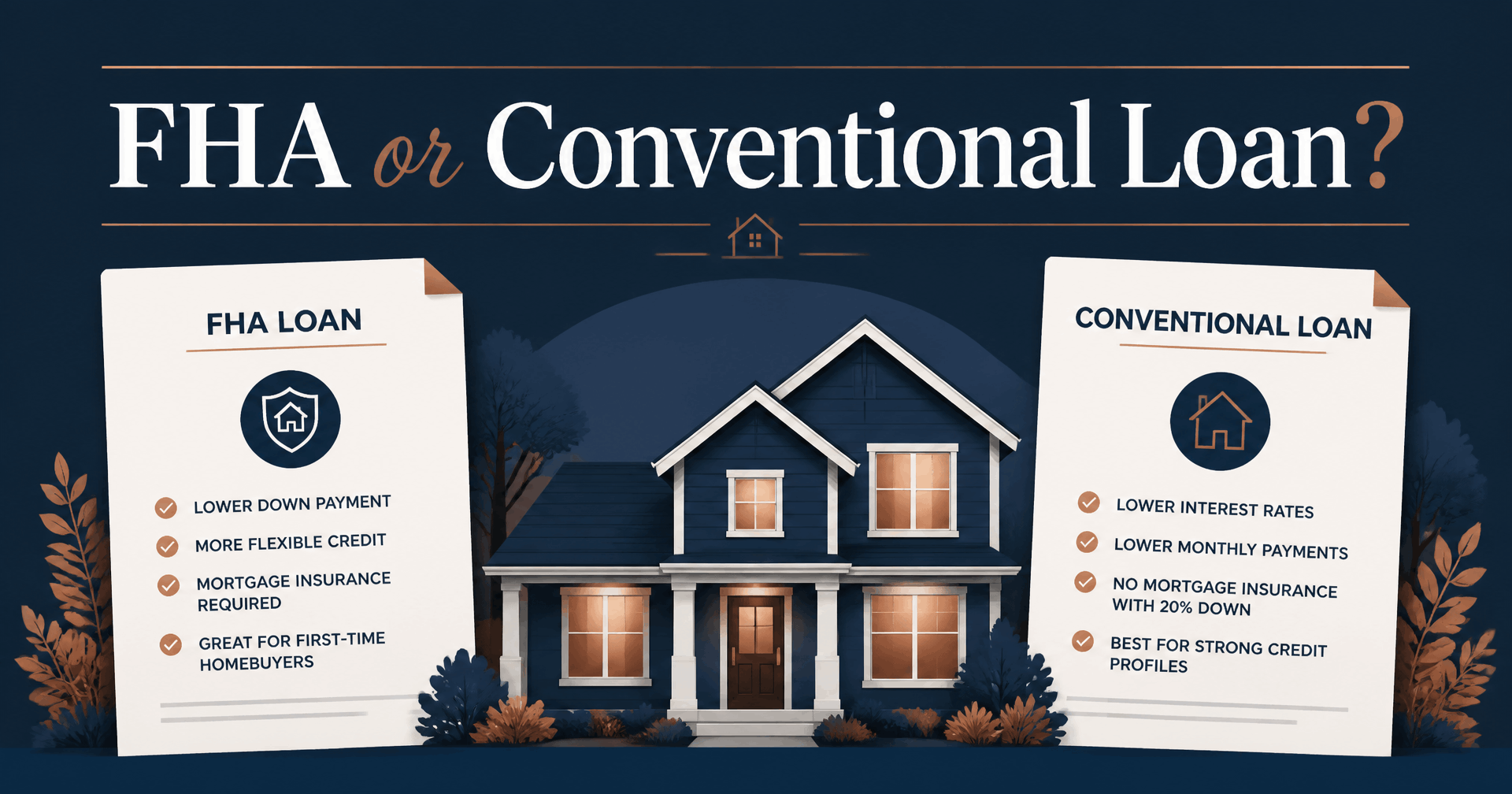
It depends on your credit, your down payment, and how long you expect to keep the loan. FHA can make sense if your credit score is lower or your cash is limited. A conventional loan often costs less over time if your credit is strong and you can put down 5% or more, mainly because conventional mortgage insurance can be removed. Your lender can run both side by side, and I'd ask for both.
The main differences
- Minimum down payment: FHA is 3.5% with a 580+ score, or 10% for scores of 500 to 579. Conventional can be as little as 3% on some programs.
- Credit score: FHA uses 580 for 3.5% down, and lenders may set higher. Around 620 is typical for conventional.
- Upfront insurance: FHA charges 1.75% of the loan amount. Conventional has none.
- Monthly insurance: FHA charges an annual MIP. Conventional charges PMI, priced on your credit and down payment.
- When insurance ends: FHA lasts the life of the loan if you put down less than 10%, and 11 years at 10% or more. Conventional PMI can be requested off at 80% of the original value and ends automatically at 78%.
Those figures come from HUD guidance as summarized by USA Today and lender sources in 2026. Lenders can add their own rules, so confirm your numbers on a Loan Estimate.
Where FHA helps
FHA is built for buyers who are still building credit or saving. If your score is in the low 600s or you have a limited down payment, FHA may approve a loan that a conventional lender wouldn't, or at a better price. Closing costs can be partly covered by seller concessions, up to 6% of the price.
Where conventional wins
If your credit is strong and you have 5% to 10% down, conventional PMI may cost less, and the main advantage is that it can come off. FHA's 1.75% upfront premium is usually financed, so it adds to your balance. On a $400,000 purchase with 3.5% down, that's about $6,755 added to the loan according to one lender comparison.
What about sellers?
You may hear that sellers don't like FHA offers. FHA appraisals include property condition standards, so some sellers worry about repair requirements. That doesn't make FHA a bad choice. In a multiple-offer situation, though, a conventional offer may look simpler. Ask your agent how offers are being received locally.
A way to compare
- Ask your lender for a Loan Estimate for each loan type, at the same price and down payment.
- Compare the monthly payment, cash to close, and mortgage insurance.
- Ask when the insurance ends and what it would take to remove it.
- Consider a refinance later. It's often possible, never guaranteed.
FAQ
Can I switch from FHA to conventional later?
Often through a refinance when you have enough equity and credit. The upfront FHA premium isn't refunded, and a refinance has its own costs.
Is FHA only for first-time buyers?
No. Repeat buyers can use it too.
Is conventional PMI always cheaper?
Not always. With lower credit scores, conventional PMI can cost more than FHA.
Does FHA have loan limits?
Yes, they vary by county. Ask your lender for the current limit in your area.
What about VA?
If you're eligible, VA is worth comparing as well. I'm happy to point you to a lender who can run it.
Next step
Buying in Maryland or DC? Start with my buyer resources, or contact me. Want to talk it through? Grab a free 15-minute call at calendly.com/michaelwaderealtor/15min. No pressure.
Recent Posts